COMPARATIVE STUDY OF TOOL WEAR ESTIMATION IN DRILLING
SHRIHARSHA B.R. and H.V. RAVINDRA
Dept. of Mech. Engg., P.E.S.C.E., Mandya – 571 401.
ABSTRACT:
Tool wear monitoring and estimation are essential for
improved productivity of manufacturing systems. In order to study the tool wear
phenomenon, Thrust, Torque, Tool - Tip Temperature and Vibration signals were
measured during drilling and an attempt was made to obtain a clear insight of
the signals involved. Simple functional relations between the parameters have
been plotted to derive a basis for more detailed analysis and arrive at
possible information on signal-wear relationship. Further to avoid the random
variations in material properties more sophisticated method of signal analysis
methods like Multiple Regression Analysis and Group Method of Data Handling
(GMDH) were used for tool wear estimation. Further, the comparison studies of
Multiple Regression Analysis and Group Method of Data Handling were made. It
was found that at higher speeds and feed, the multiple regression analysis
seems to be the best.
INTRODUCTION:
In any manufacturing process, the
production of a part with specific shape and dimensional accuracy will be
intended without damaging the tool. But tool wear is a predominant phenomenon
to be predicted, detected for efficient production. Tool wear sensing
contributes greatly towards optimization of the cutting process, efficient tool
change policies, improved product quality control and lower tool costs. Hence,
sensor based monitoring systems have become increasingly useful in improving
the efficiency of the manufacturing systems [1].
Several methods have been investigated for monitoring tool wear
with signals such as cutting force, power, tool tip temperature, vibration and
acoustic emission [2]. Most of these techniques have been applied quite
successfully to a certain extent, but with some limitations [3]. The method
used for calculations of thrust and torque in drilling has shown that they
depend on all the drilling parameters. Also to validate the theoretical model,
a range of experimental tests has been undertaken and then compared with the
theoretical values of thrust and torque. The comparison shows good agreement
between predictions and experimental results [4, 5]. Also, for predicting
thrust, torque, radial forces in drilling, an analytical model was developed
that includes the effect of the drill bit transverse deflections, which lead to
variations from the mean values in the cutting forces. This model when drill vibrations
are negligible used for predicting the mean torque and thrust in drilling, as a
result the predicted values are in good agreement with the experimental data
[6].
For drill bit transverse
vibration, a dynamic model was developed. The model provides good qualitative
agreement with experimental data for the effects of design and process
parameters on drill vibrations and stability [7].
Drill bit is a complex tool
and it is impossible without using multiple sensors to monitor it. Therefore by
using multiple sensor systems for tool condition monitoring in drilling, the
productivity can be improved [8, 9].
The present work aims at devising multi-sensory schemes for tool wear estimation in drilling process, by measurement of thrust, torque, tool tip temperature and vibration. Further to avoid the random variations in material properties more sophisticated method of signal analysis like Multiple Regression Analysis and Group Method of Data Handling (GMDH) were used for tool wear estimation [10]. These methods have been explored for their capability to integrate information from different sensors.
MULTIPLE
REGRESSION ANALYSIS:
The objective of multiple regression
analysis is to construct a model to explain, as much as possible, the variability
in a dependent variable, using several independent variables. The model used is usually a linear model,
though some times non liner models are also constructed. The least squared
estimates are the best linear unbiased estimates of the dependent variable
[11].
GROUP METHOD OF DATA HANDLING (GMDH):
Among the widely used methods for empirical analysis of data and model
building multiple regression analysis is well known technique. One of the major
problems associated with use of regression has been the need to specify
functional formulation. The linear
assumption is not valid in all cases and also an infinite variety of non-linear
functional forms exist. This might not
cause many difficulties when model building is used to determine causal
relationships. The problem assumes
significance where a dependent variable is to be estimated from measured
variables. In such cases, while it is
known that some of the measured variables are to be used, the nature of
relationship and relative importance of these variables is unknown. It would be preferable in such cases to use
the data to determine both the nature of function and parameters of the
function. This is the motivation for
the development of self-organizing methods in modeling; GMDH is one such method
[12, 13].
The approach is to fit a high degree polynomial using a multilayered
network like structure. Each element in the network is a partial polynomial (a
quadratic function) of two inputs. The coefficients of the quadratic function
are determined by data from training set (certain percentage of data-set is
taken as training set to learn the model; the remaining data-set is used for
checking the model). All possible combinations of inputs, taken two at a time,
are evaluated. The combinations that are allowed to pass to the next year and
self organizing is terminated when optimum complexity is reached by evaluation
of a criterion function from data in the checking set.
Three different criterion functions, viz., regularity, unbiased and
combined criterions were attempted. Regularity criterion has good predictive
power but sensitive to noise. Unbiased criterion selects models that are
insensitive to data from which it is built and hence gives good noise immunity
but may not have good predictive power. Combined criterion is the combination
of regularity and unbiased criterions [14]. GMDH has been applied to the
modeling and optimization of machining processes. Also it was observed that
among multiple regression analysis, best results could be obtained from GMDH
and neural networks [15].
In the present paper, applications of
multiple regression and GMDH to tool wear estimation is discussed and
compared. Various heuristics of GMDH
appropriate for the present work are detailed in Appendix.
EXPERIMENTAL
WORK:
The experimental work consisted of drilling Mild Steel plate using High
Speed Steel Drill Bit. The drilling was carried out in Automatic Drilling
Machine. The parameters like thrust, torque, tool tip temperature and vibration
were measured for different operating conditions. Digital Drill Tool
Dynamometer is used to measure both the thrust and torque of the drill bit. The
temperature readings were obtained by using Infrared Thermometer (WAHL HEAT
SPY). The vibration readings were recorded using Oscilloscope (100 MHz).
The experiments were performed to obtain
progressive Flank wear. These experiments were conducted with different speed
and feed combinations. Drilling was stopped at regular intervals and the width
of the flank wear was measured using Toolmakers Microscope.
The composition of work material is given
in the Table 1. The tool material specifications are given in Table 2. The
cutting conditions used during the experiments are given in Table 3.
Table
1: WORK MATERIAL COMPOSITION
|
Work Material |
C-60 Steel |
|
Hardness |
BHN 225 |
|
Composition in Percentage |
C-0.55 to 0.65 Mn-0.50 to 0.80 |
Table 2: TOOL MATERIAL
SPECIFICATION
|
Tool
material |
High
speed steel |
|
Diameter
of the drill bit used |
10mm. |
|
Chisel
edge angle |
120º
to 135º |
|
Helix
angle or rake angle |
30º |
|
Point
angle |
118º |
|
Lip
clearance angle |
12º |
Table 3: EXPERIMENTAL
CONDITIONS
|
a) Effect of thrust, torque, temperature on flank
wear |
|
|
Speed (m/min) |
9, 18, 22 |
|
Feed
(mm/rev) |
0.190 |
|
b)
Effect of thrust, torque, temperature on flank wear |
|
|
Feed (mm/rev) |
0.095, 0.190, 0.285 |
|
Speed (m/min) |
15 |
|
c) Effect of thrust, torque, temperature and
vibration on flank wear |
|
|
Feed (mm/rev) |
0.190 |
|
Speed (m/min) |
18, 22 |
RESULTS AND DISCUSSIONS:
Initially, Simple functional relations
between the parameters have been plotted to derive a basis for more detailed
analysis and arrive at possible information on signal-wear relationship.
Effect of Speed and Feed
on Flank Wear
Fig. 1 gives the measured flank wear at three different
speeds (15 m/min, 18 m/min, and 22 m/min) and at a constant feed of 0.190
mm/rev and Fig. 2 gives the measured wear at three different feeds (0.095
mm/rev, 0.190 mm/rev. and 0.285 mm/rev.) and at a constant speed of 15 m/min.
It can be observed that the wear curves have clearly defines the regions of
running in, steady state and rapid wear curves. Hence, this implies that the
drilling is done at near optimal regions. Also, it was observed that at higher
speeds and feeds the tool wear is maximum.
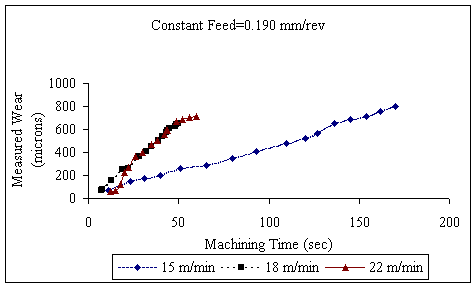
Fig. 1 Flank Wear
v/s Machining Time
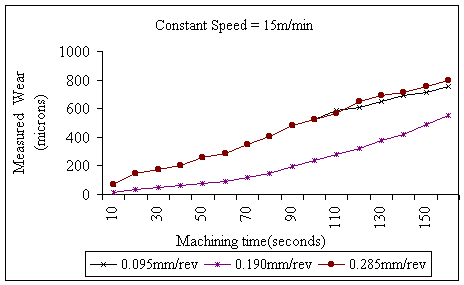
Fig. 2 Flank Wear
v/s Machining time
Effect of Thrust, Temperature, Vibration on Flank Wear
Fig. 3
gives the plot of thrust, torque, temperature and maximum measured wear for
different duration of drilling at 9 m/min cutting speed and 0.190 mm/rev feed.
There is an increase in thrust and temperature with progressive increase in
flank wear. But there is a negligible increase in torque. Therefore it is
neglected because of least variations. These effects were also same for the
data’s taken at higher speeds and constant feed. Also, similar effects were
observed for increasing feed and constant speed.
Fig. 4 shows the vibration signals [Vavg, Vrms, Vp (in voltages) along with thrust, temperature and measured wear for 22 m/min cutting speed and 0.190 mm/rev feed. It was observed that the flank wear increases with the increase in vibration signals such as VP, thrust and temperature. But VAVG and VRMS become constant throughout and therefore they are neglected. These features are also same for the data’s taken at higher speeds.
By observing the above
signals it was found that, there was random increase of thrust, vibration and
tool wear with the increase in speed and feed. This can be attributed to random
variations in material properties. Under such conditions, any system based on
simple threshold criterion to estimate the end of tool life can produce wrong
diagnosis. Thus, there is a requirement for more sophisticated methods of
signal analysis like Multiple Regression Analysis and Group Method of Data
Handling (GMDH). These methods are robust for random variations in the
variables and is capable of integrating
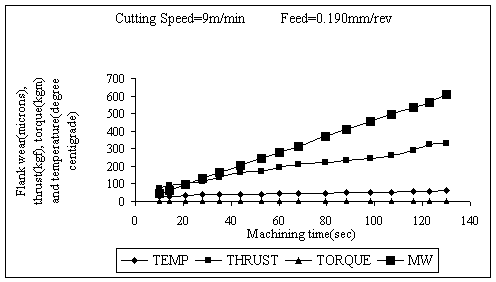
Fig. 3 Flank wear, thrust, torque and temperature with machining time
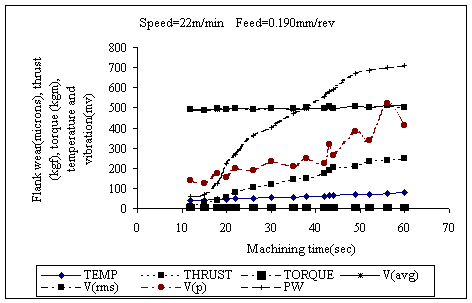
Fig. 4 Flank wear, thrust, torque, temperature and vibration with
machining time
information such as, measured drilling parameters (thrust, torque,
temperature and vibration), with feed and speed.
TOOL WEAR ESTIMATION
For effective and reliable
monitoring and thereby estimating tool wear, the signals due to thrust, torque,
temperature and vibration of the tool can be supplemented. With the
introduction of a variety of data, MULTIPLE REGRESSION ANALYSIS and GMDH become
more appropriate for estimation of tool wear.
The two methods of specifying input data were used. This
consisted of considering flank wear as a function of the following
combinations.
(a)
Temperature, Thrust,
Torque.
(b)
Temperature, Thrust and
vibration (VP).
MULTIPLE REGRESSION ESTIMATES
>From
Fig. 5, the estimates from the regression analysis at 22 m/min cutting speed
and 0.190 mm/rev. feed were plotted. It was observed that the measured wear was
well correlated with the predicted wear. The same effects were observed for
other cutting conditions. These effects were observed for the first set input
combinations. Also, the same effects were observed for second set input
combination as shown in Fig. 6.
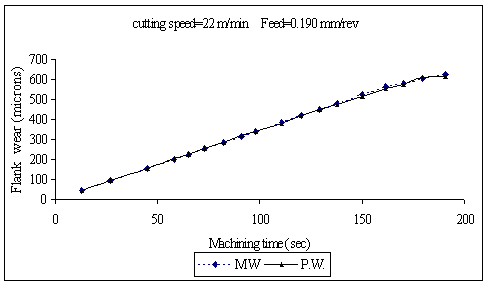
Fig.
5 Multiple Regression Estimates
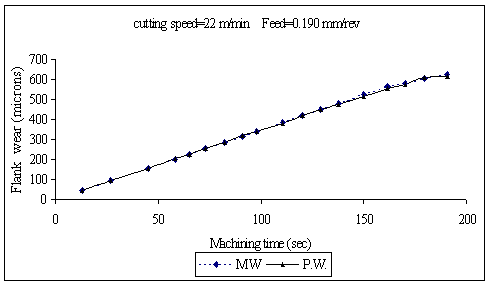
Fig. 6 Multiple Regression Estimates
GMDH ESTIMATES
Here three criterions namely, regularity,
combined and unbiased criterion were used for guiding the self-organization
procedure. Fig. 7 gives the plot of estimates for 9 m/min cutting speed and
0.190 mm/rev. feed for the flank wear. The estimates from regularity, combined
and unbiased criteria were plotted. It was observed that the estimates of
regularity and combined criteria are correlating with the measured wear. Due to
poor correlation, the unbiased criterion has not been considered. The same
effects were also observed for varying cutting speeds and constant feed. These
effects were observed for the first set input combinations. Also, the same
effects were observed for second set input combination as shown in Fig. 8.
By observing the plots, it was concluded that the unbiased criterion
does not have good predictive power and usually tends to wrongly estimate the
variations in the dependant variable. The Regularity criterion, which has
better predictive ability, works well in the absence of noise. It has seen that GMDH precisely estimate the
tool wear by presenting a closed representation with the observation especially
at high drilling conditions i.e., with higher drilling conditions, the tool
exhibited rapid wear in relatively shorter duration of drilling, maintaining
the correlation between the tool wear and the drilling parameters. Also it was
concluded that the tool wear estimates are required only after the tool has
passed through the running in stage of wear.
Fig. 9 gives the plot of estimates from regularity and combined
criteria for different drilling conditions. Also the regression estimates those
are correlating well are considered
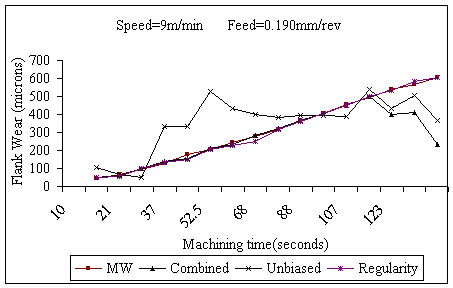
Fig. 7 GMDH ESTIMATES
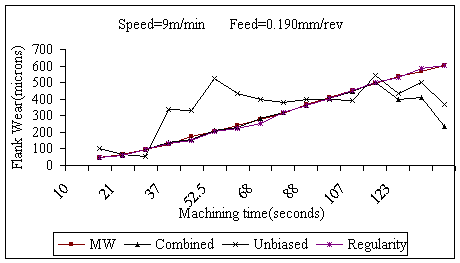
Fig. 8 GMDH ESTIMATES
for the comparison purpose. It was
observed that the estimates from regression analysis were well correlated compared
to GMDH estimates. At higher speeds and feed the multiple regression seems to
be the best. But considering other variables such as work material properties,
tool material, GMDH with regularity criterion may be better. Good correlation
was obtained for all by using regularity criterion.
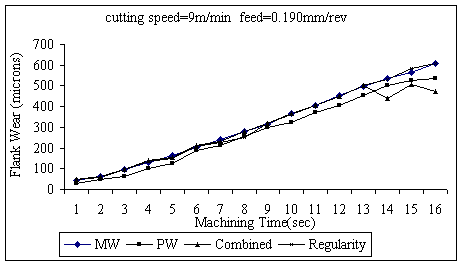
Fig.
9. Comparison of Regression and GMDH Estimates
CONCLUSION
·
Experimental work was
designed to use multiple sensors and to obtain data for sharp tool and for
different stages of flank wear.
·
Experimental data was
used to establish the effect of drilling conditions on drilling parameters, and
tool wear.
·
The multiple regression
analysis and group method of data handling has been attempted for tool wear
estimation using two types of input variable combinations. This has resulted in successful
implementation of tool wear estimation.
·
For GMDH 3 different
criterion functions have been used. Based on the present work, it can be
concluded that the regularity criterion functions well for input variables like
steady state drilling parameters like Thrust, Torque, Temperature and
vibration.
·
Multi sensory approaches
have been proposed and implemented. The
ability of above-mentioned algorithms to effect integration of sensor
information has been established.
APPENDIX
Heuristics
Used
Several heuristics used to guide the
self-organization are described below.
The order of data: In the Present
work, data with the largest variance is put in the training set. The variance for ith data point is
given by
m
Di2
= å (Xij – Xj)2/sj2 (1)
I = 1
Where Xj
= means for jth variable and
n
sj2 =
(1/n) å (Xij – Xj )2 (2)
i = 1
Number of Data
in Training Set
Estimates were obtained for 25%, 50% and
62.5% of total in the training set. The
best was selected from these.
Number of
Variables Selected at Each Layer
This is usually
taken as a fixed number of a constantly increasing numbers [usually given as a
fractional increase in number of independent variables present in the precious
level]. In this work, a fixed number,
equal number of input variables, was taken.
This was done to simplify the computational requirements.
The Criterion
Function Evaluated on Checking Set
Three different
criterion functions – regularity criterion, unbiased criterion and combined
criterion were attempted.
Regularity
criterion is given by the equation
n
å (Yi - Zij ) 2
i= nt+1
 rj2 = (3)
n
å Yi2
i= nt+1
j = 1, 2……….m(m-1)/2
Where Zij
refers to estimate of ith dependant variable using jth
equation.
Regularity
Criterion has good prediction power but sensitive towards noise.
Unbiased criterion selects models that are insensitive to data from which it is built and hence gives good noise immunity but may not have good predictive power. The criterion value is given by
n
å (Yi - Zij ) 2
i= 1
 Uj2 = (4)
n
å Yi2
i= 1
j = 1,2…..m(m-1)/2
Combined
criterion is combination of both of these and it is given by the equation
Cj2=
rj2+ uj2.
In the present
work all the three criterions were considered.
NOTATIONS USED
MW Measured wear (microns)
PW Predicted wear (microns)
Vp Peak voltage (volts)
Vrms Root mean square voltage (volts)
Vavg Average voltage (volts)
M/C Time Machining time (seconds)
Temp Temperature (°C)
Thrust Thrust in Kgf
Torque Torque in Kg-m
REFERENCES
1. Tonshoff,H.K., Wulsbedg, J.P.., Kals, H.J.J., Konig,
W., and Vam Luytervelt, C.A., Developmentsand trends in monitoring of machining
process, CIRP Annals, 37, 611-622, 1988.
2. Lister P. M., and Barrow, G., Tool condition
monitoring systems, Proc. 27th MTDR Conf., pp.271-288.1986.
3. Cook N.H. Tool wear sensors, wear, 62, pp.49-57, 1980.
4. Mustapha Elhachimi, Serge Torbaty, Pierre Joyot,
“Mechanical Modeling of high Speed Drilling. 1: predicting torque and thrust”,
International Journal of machine tools and Manufacture, 39, 553-568, 1999.
5. Mustapha Elhachimi, Serge Torbaty, Pierre Joyot,
“Mechanical Modeling of high Speed Drilling. 2: predicted and experimental
results”, International Journal of machine tools and Manufacture, 39, 569-581,
1999.
6. Diana M. Rincon and A.galip Ulsoy, ‘Effects of Drill
Vibrations on Cutting Forces and Torque’, Annals of CIRP Vol. 43/1/1994.
7. A. Galip Ulsoy and Ozan Tekinalp, “ Dynamic Modeling
of transverse Drill bit Vibrations”, Annals of CIRP Vol. 33/1/1984
8. A.
Noori-Khajvi, R.Komanduri, “ On multisensor approach to drill wear monitoring”,
Annals of CIRP Vol. 42/11993.
9. G.byrne, D. Donfeld, I.Inasaki, “Tool condition
monitoring – the status of research and industrial application”. Annals of CIRP
Vol. 44/2/1995.
10. Uematsu, T., and Mohri, N. , Prediction and detection of cutting tool failure by modified
group method of data handling. INT. Journal of machine tool design and
research, 26(1), 69-80, 1986.
11. T.H. Wannacott and R.J. Wanancott, Regression- A
second course in statistics, John Wiley, 1981.
12. Farlow, S.J. (ED) , Self organizing methods in
modeling. (USA: Marcel Dekker), 1984.
13. Ivaknenko, A.G., polynomial theory of complex systems.
IEEE Transactions on systems, man and cybernatics, pp. 346-378, 1971.
14. Ravindra H.V., Tool condition monitoring in turning
using cutting force, vibration and acoustic emission, Ph.D Thesis, IIT Madras
(India), 1993.
- Chryssolouoris, G. , and Gullot, M., A comparison
of statistical and AI
approaches to the
selection of process parameters in intelligent machining. Transactions of ASME,
Journal of Engineering for Industry, 112 (2), 122-131, 1990.